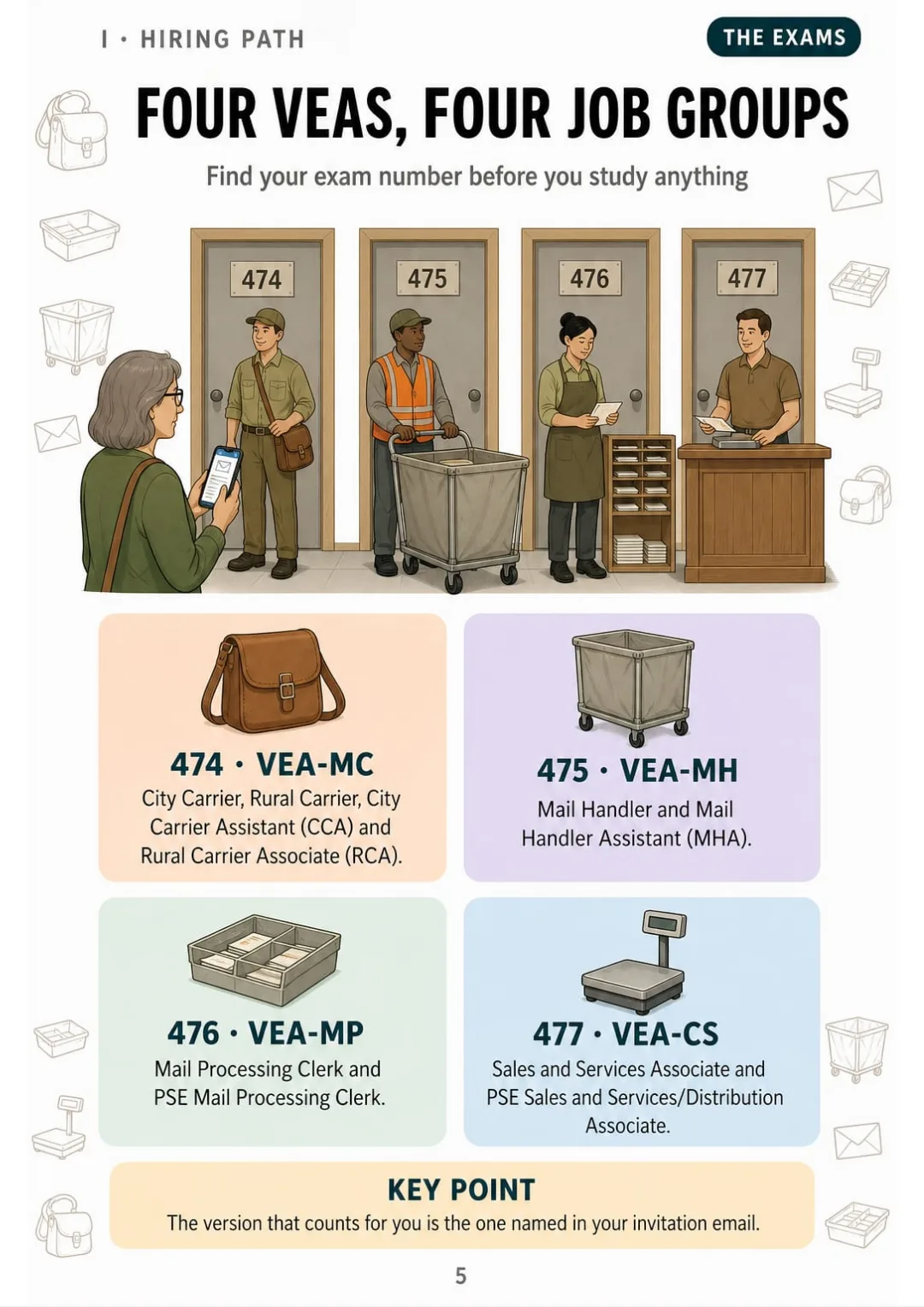
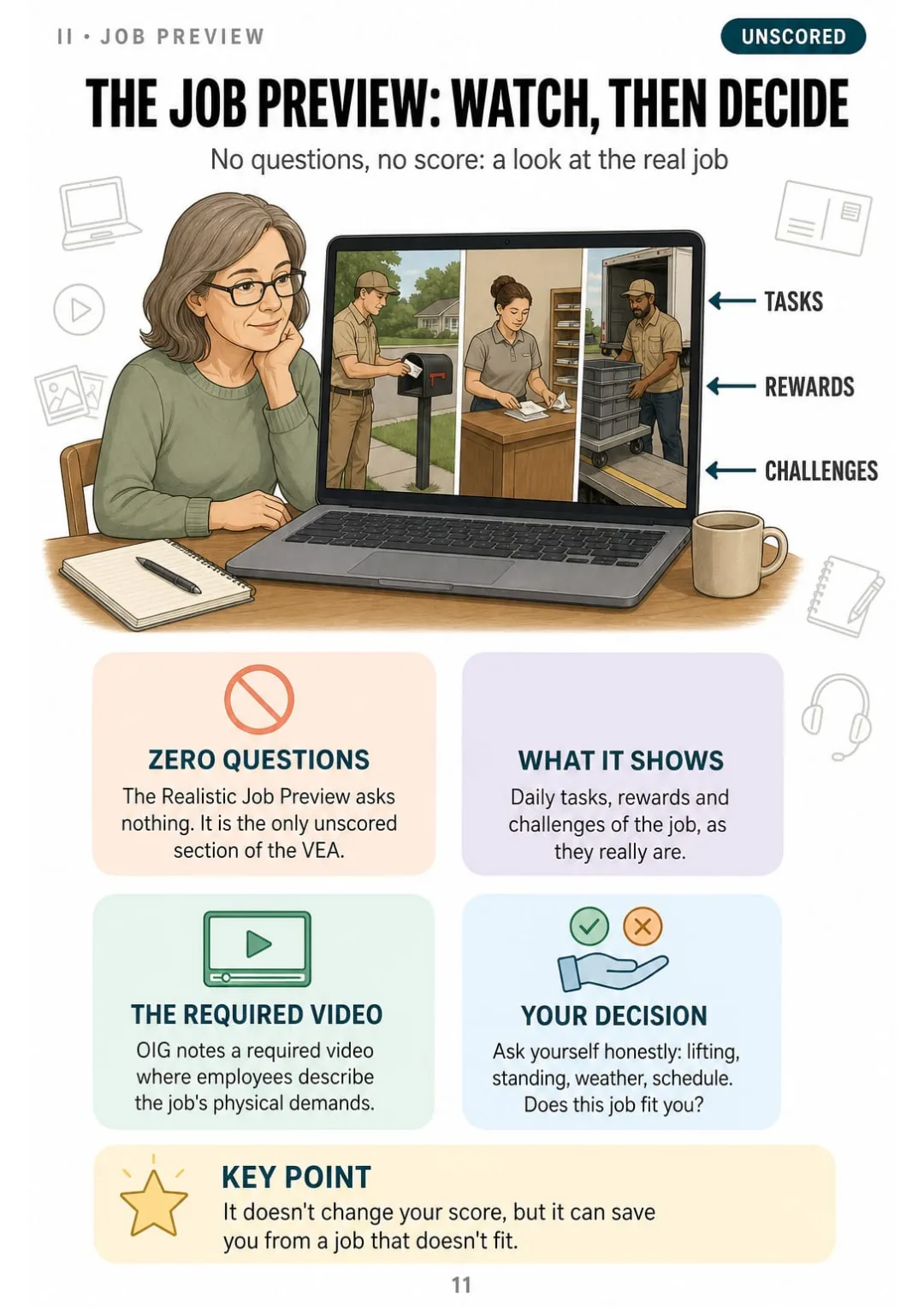
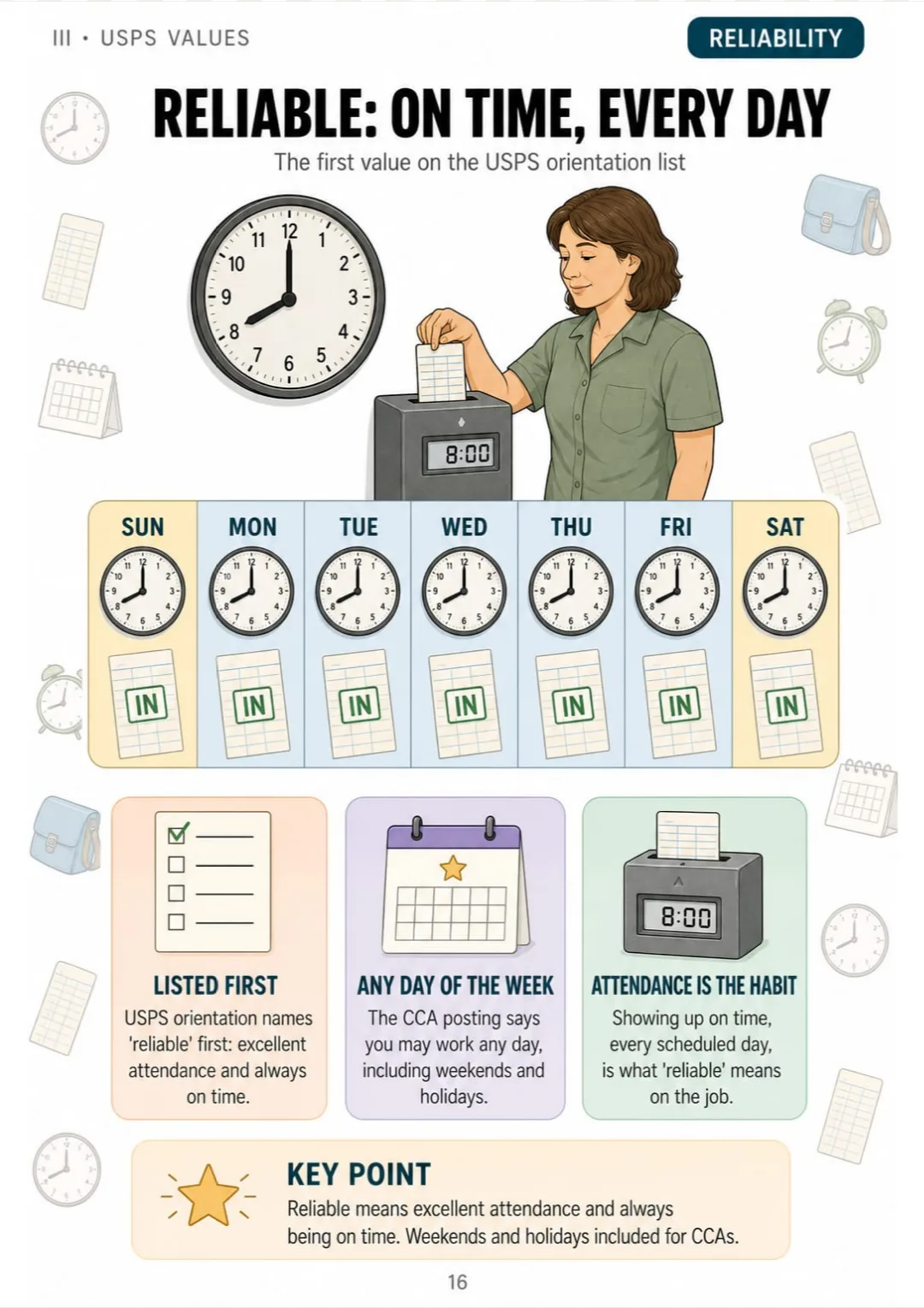
The 72-hour window, the work situations (most likely / least likely), your work history and the address check: the free USPS guide explains them in paragraphs. Here each one fits on one page, with a drawing and callout boxes with what to remember. All four versions are covered, so you can see what yours asks. 66 drawn pages.
🔒 Secure checkout · PDF by email · 30-day guarantee
One topic per page, the drawing that shows you how it works and the boxes with what you need to know:


Swipe to see more →
These are real pages from the book. The table of contents is the full one: 11 parts and 62 topics.
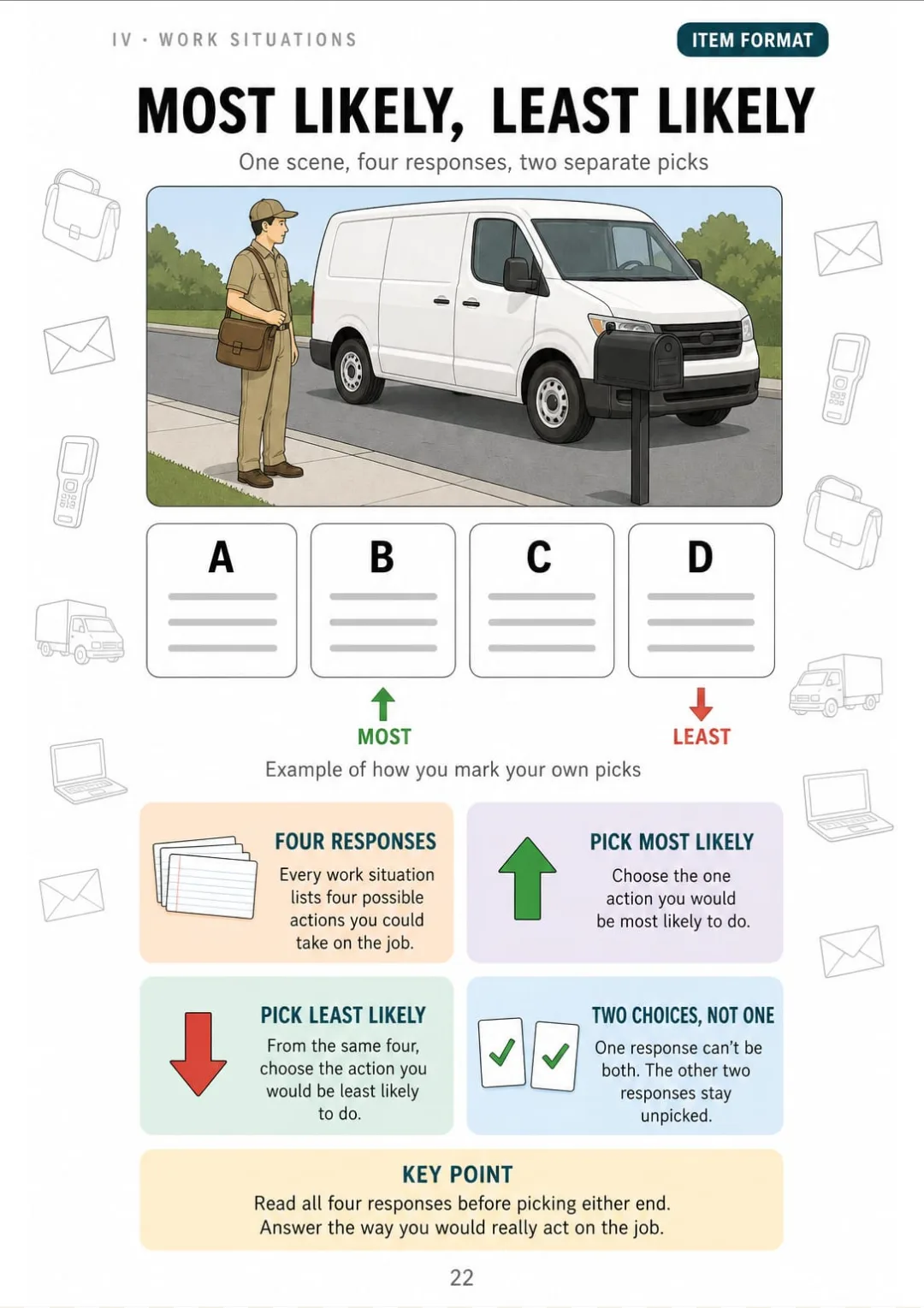
A work situation opens on screen. Four responses, and all four sound reasonable...
...you pick one, second-guess it and change it. Nobody showed you how to read the scenario.

Here it's one page: a decision ladder with four response cards, and the scenario read in three steps: who's involved, what's happening, what's at risk.
And on the pages next to it, each of the six USPS values gets its own drawing: reliable, safety before speed, sanctity of the mail, following procedures, customer service and teamwork.
First you see why one response fits what USPS values. Then the order sticks on its own.

The exam and the steps after it, the Job Preview, what USPS values, work situations, work history, work style, the accuracy check, Publication 28, route safety, test day and a final review: 66 pages, all drawn
Picture this:
Instead of rereading half a page about most likely / least likely without being able to see how it works...
...you open the page and find a decision ladder with four response cards, from most likely at the top to least likely at the bottom.

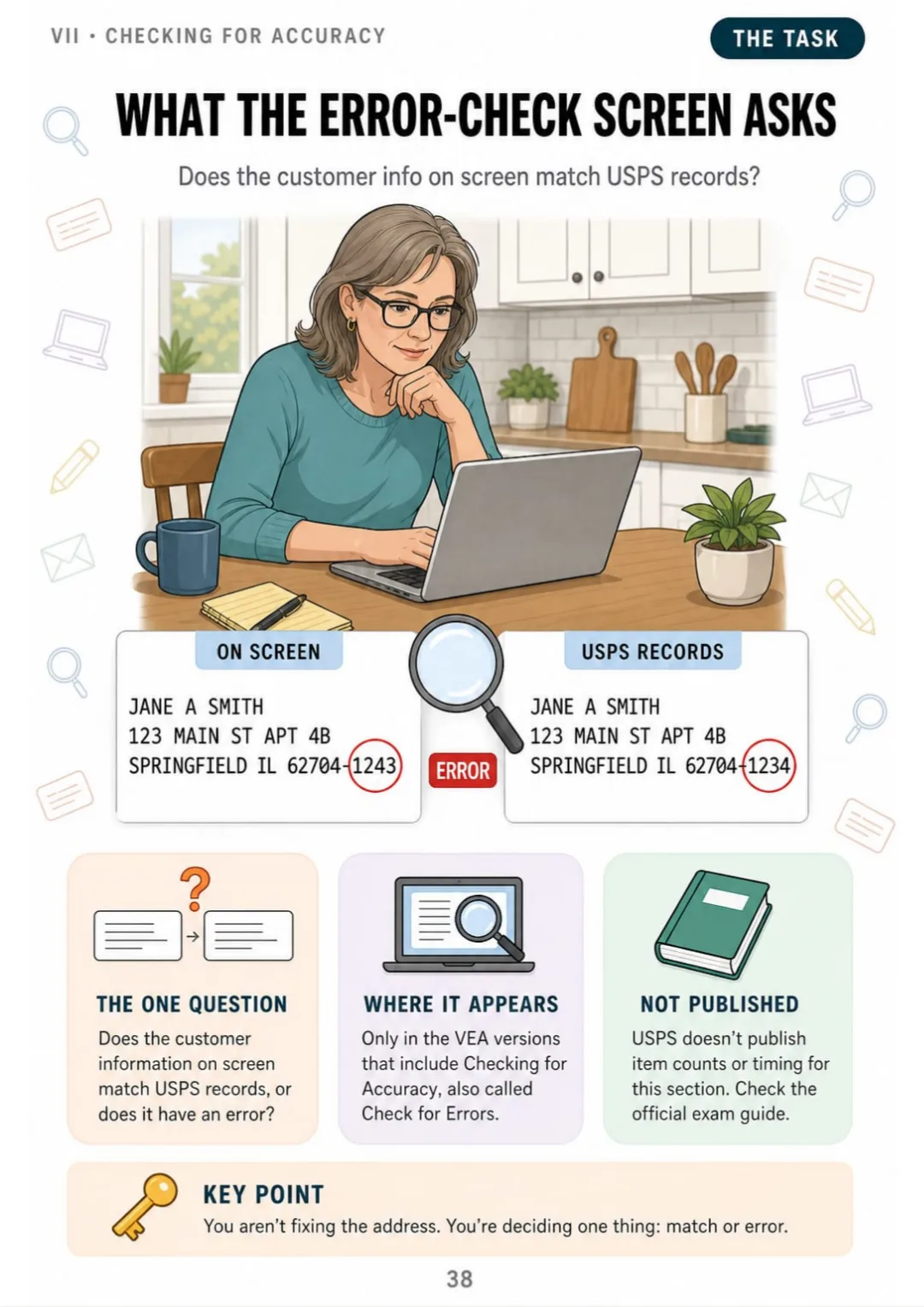
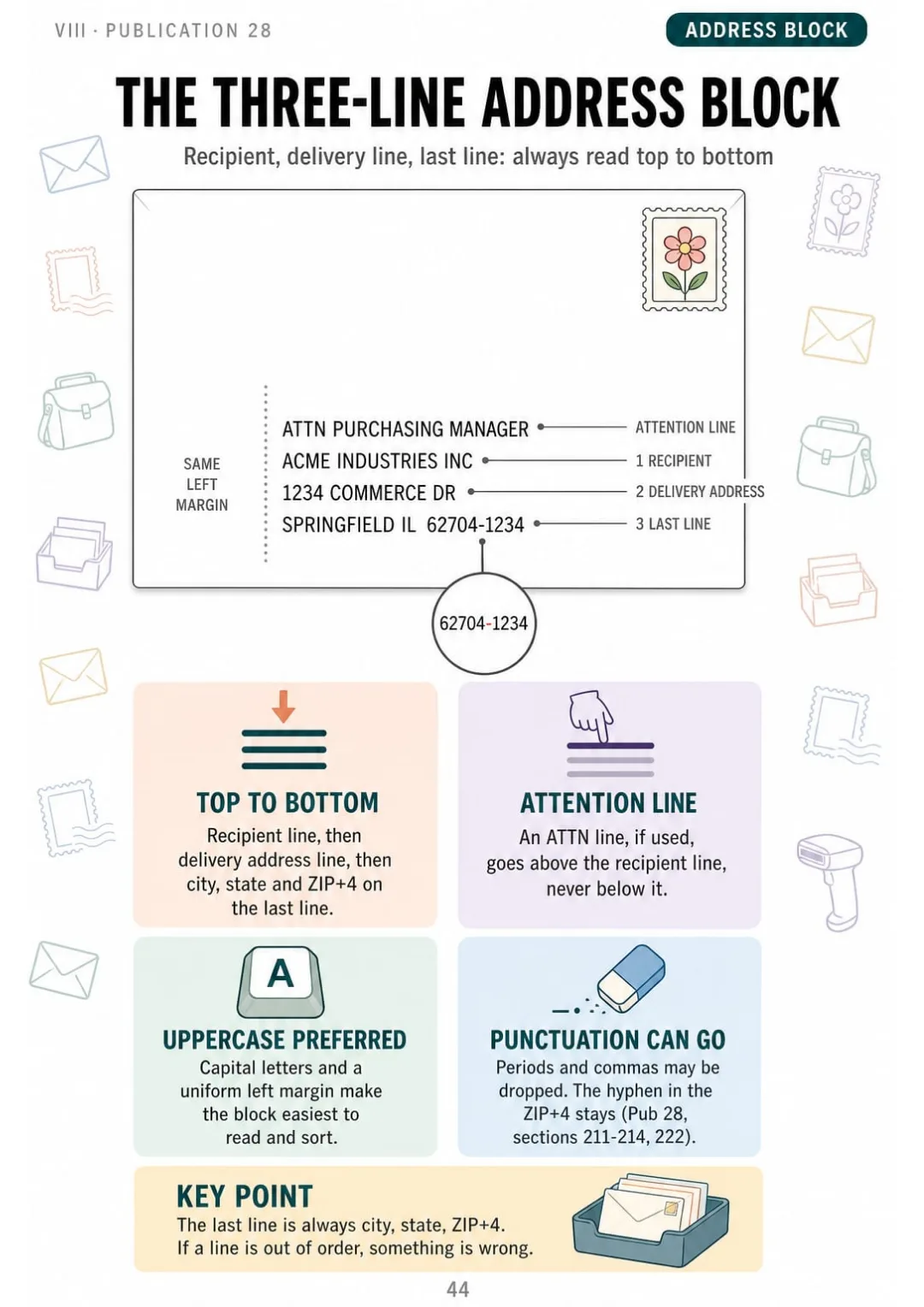
And the 72-hour window, USPS values, the three-line address block, the right-to-left check and route safety become drawings and tables you read at a glance.
You stop repeating and start understanding.
That's exactly what The Postal Exam Sketchbook does. It's not “just another study guide.” It's 11 parts and 62 drawn topics, and at the end a review part with VEA myths, an address-check speed drill and a 72-hour countdown checklist. Because what your brain sees in order, it remembers.
Because what your brain sees organized, it remembers.
The four VEAs and who takes each one, the path from application to first day, the 72-hour window, the sections, the 70 passing score, retakes and fee scam alerts.
What the Realistic Job Preview is, and a day in each role: carrier, mail handler, processing clerk and window associate.
The six values: reliable, safety before speed, sanctity of the mail, following procedures, customer service and teamwork.
How a most likely / least likely item works, reading a scenario by who, what and risk, the decision ladder and three worked cases.
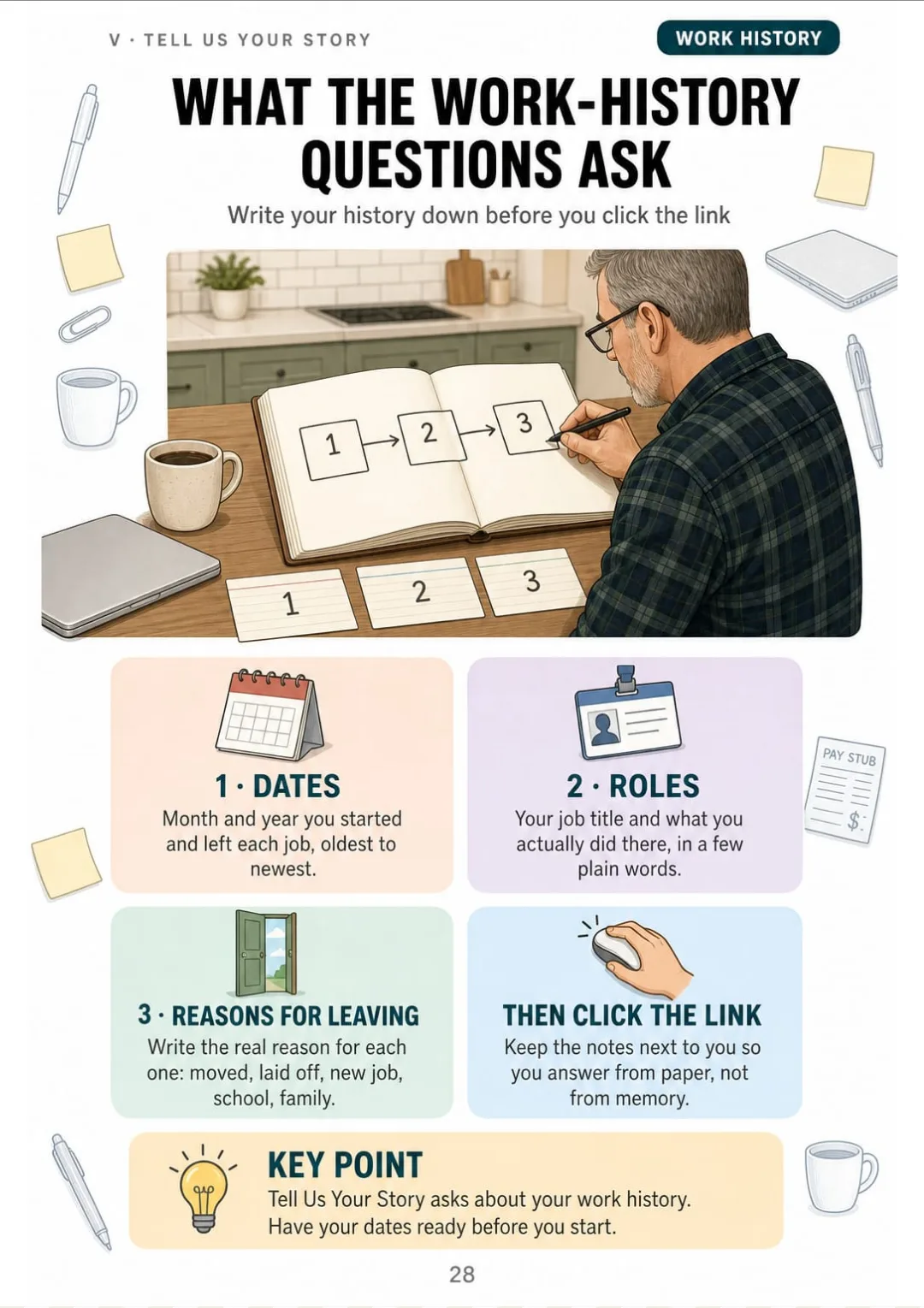
What the work-history questions ask, using school, sports or clubs if you have no job yet, attendance, physical work and answering honestly.
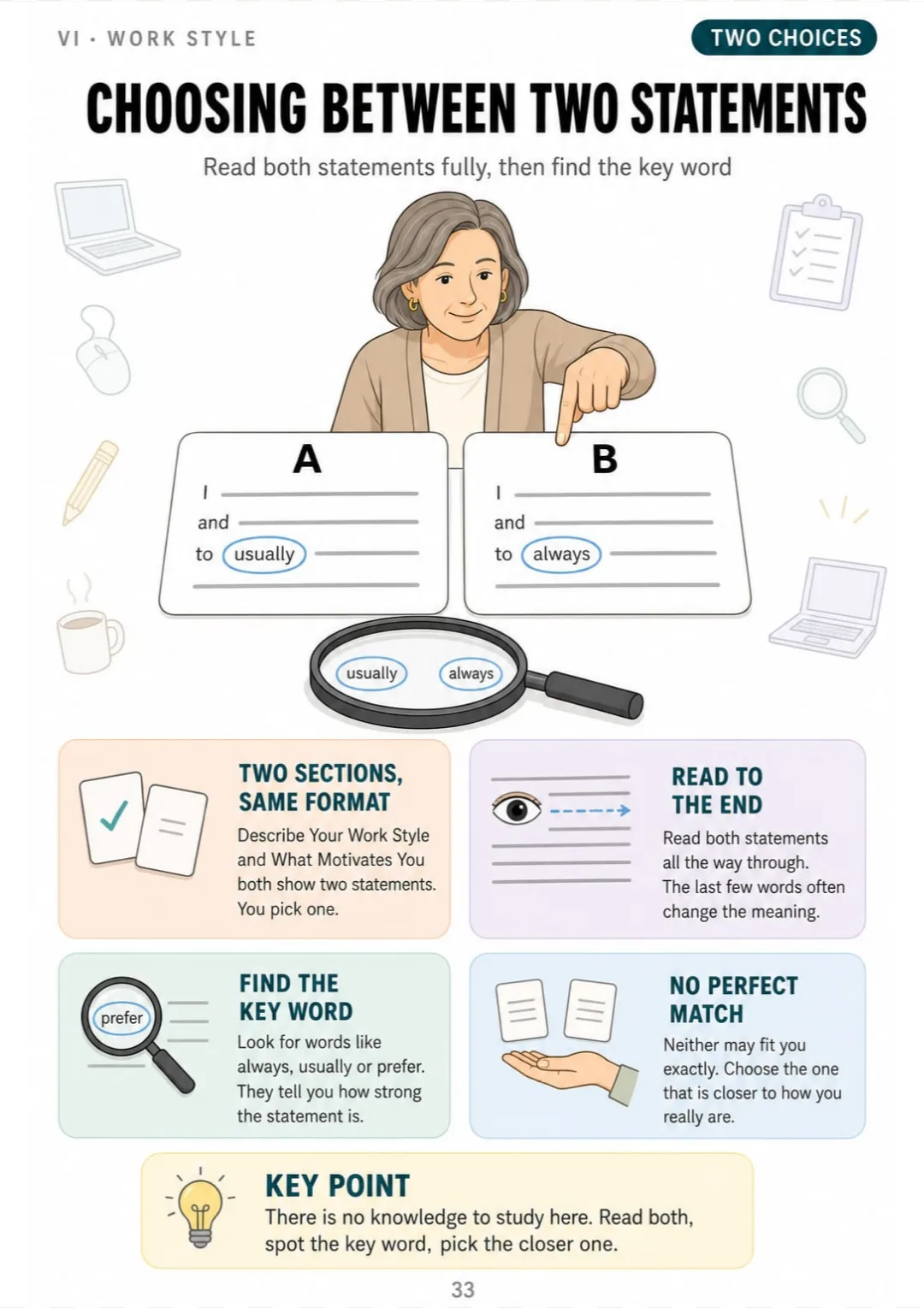
Choosing between two statements, describing your work style, job preferences, why consistency beats second-guessing and choosing your job group.
The error-check screen, which VEAs include it, splitting an address into parts, comparing right to left, and number and letter traps.
The three-line address block, street suffixes, apartments and suites, directionals, state codes, ZIP+4, PO Box and rural route formats.
Dog warning cards, the satchel as a shield, the customer's side of dog safety, heat exhaustion vs. heat stroke, hydration, lifting and driving.
Your device and quiet room, accommodations and the 508 version, ranking, interviews, the background check and SF-85, orientation and academies.
VEA myths, an address-check speed drill, USPS values on one page, a 72-hour countdown checklist and the whole journey on one map.
At the end of the book: A review part: VEA myths, an address-check speed drill, USPS values on one page and a 72-hour checklist.
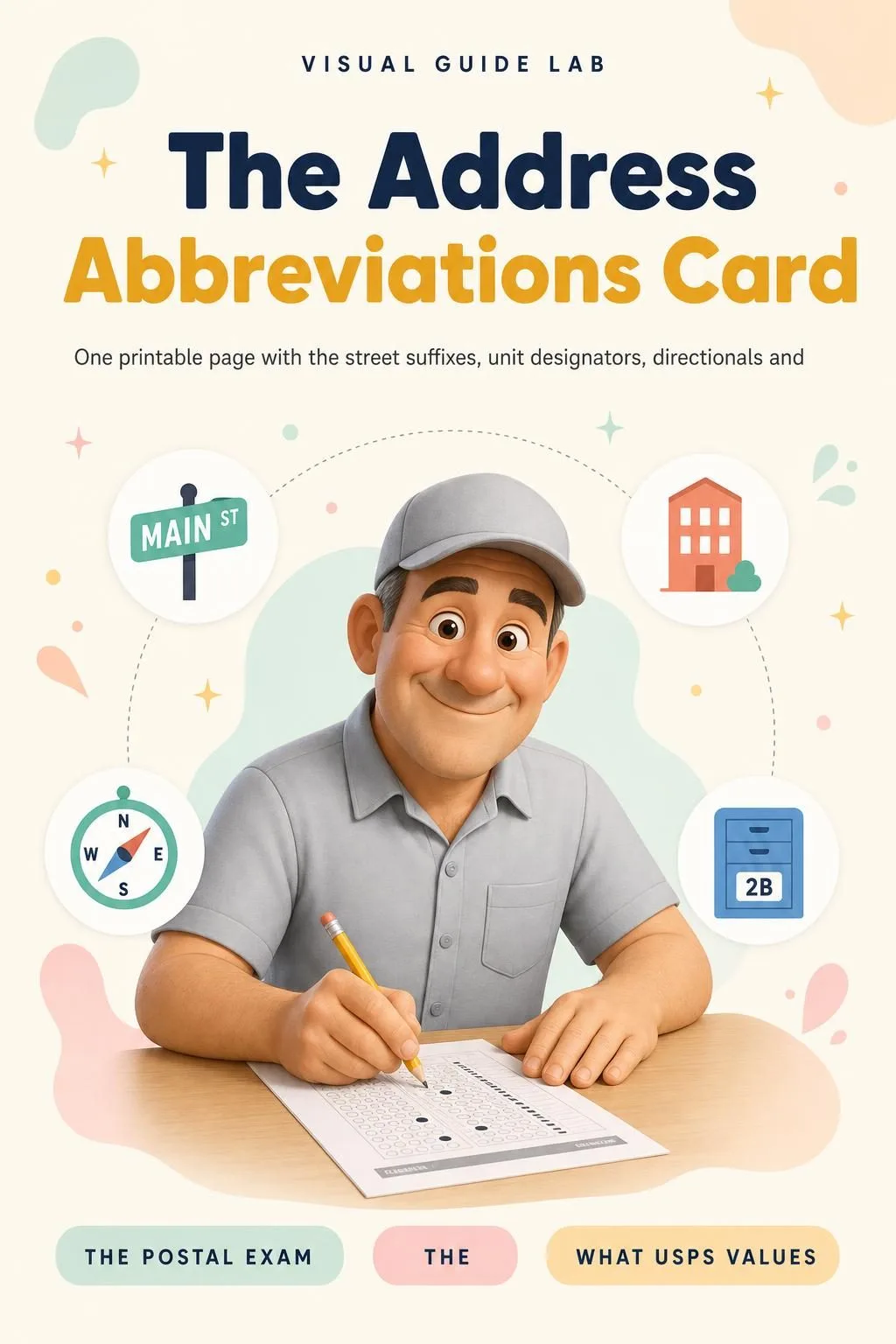
One printable page with the street suffixes, unit designators, directionals and two-letter state codes from Publication 28, so you can see them at a glance when you're checking addresses.

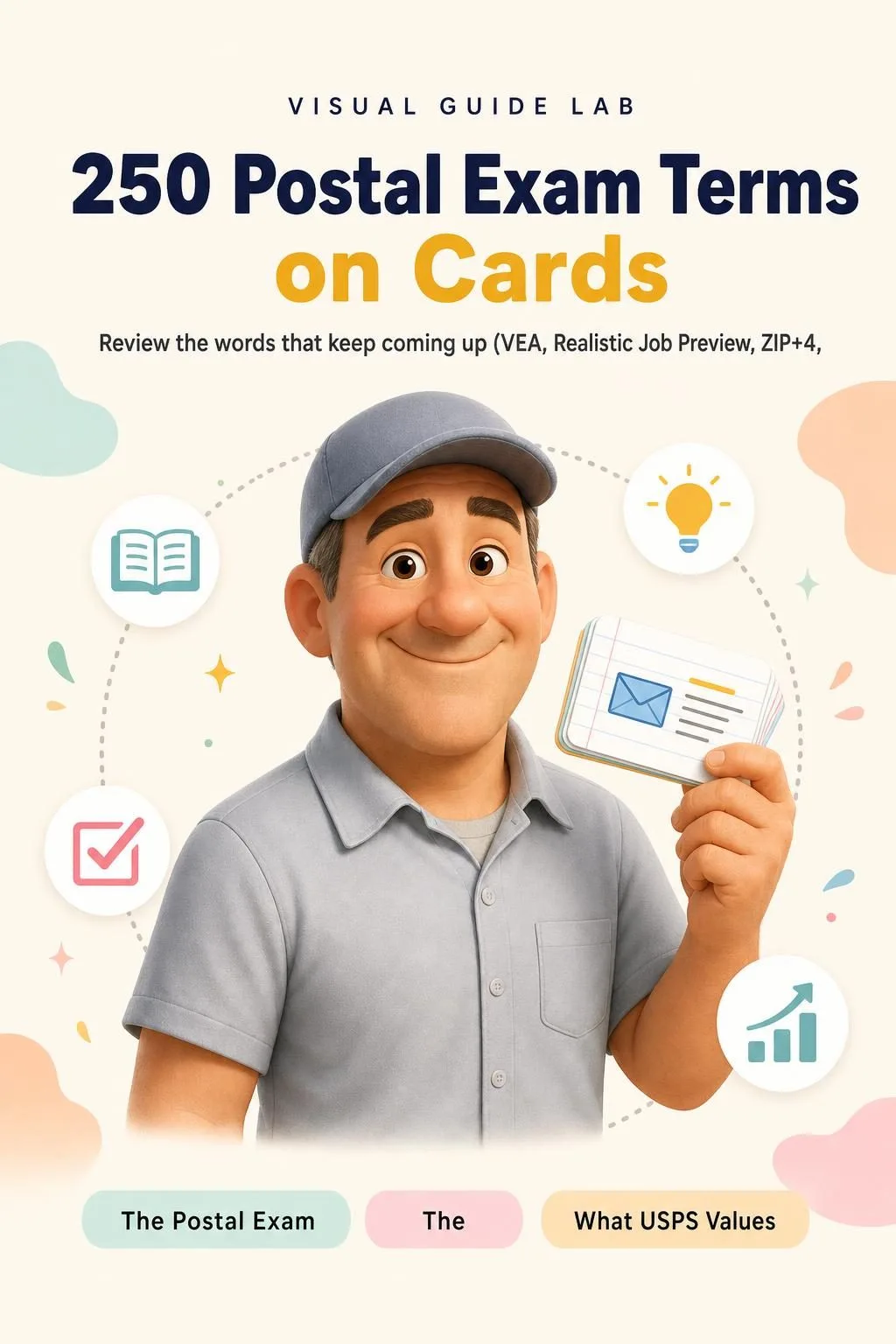
Review the words that keep coming up (VEA, Realistic Job Preview, ZIP+4, sanctity of the mail and more): the term on the front, a one-line definition and a tiny sketch on the back.
📄 This is a digital PDF book sent to your email: nothing is printed or shipped.
PDF by email: The Postal Exam Sketchbook reaches your inbox as a PDF, and the two free books come by email too. One-time payment, no installments or hidden costs.
See which VEA goes with each position and what every section asks, one topic per page, before the invitation email arrives.
The 72-hour checklist, the work situations and the address check, to review in order before you click the link.
After the 12-month wait, a fixed order for every section, so this time you start knowing what's coming.
📄 This is a digital PDF book sent to your email: nothing is printed or shipped.
30-day guarantee: tell us what didn't work and we'll refund 100%.
You have 30 days to try The Postal Exam Sketchbook and both bonus books. If it doesn't work for you, tell us what didn't work and we'll refund 100% of what you paid. One-time payment, no subscription.
You get The Postal Exam Sketchbook as a high-resolution PDF, sent by email to the address you enter at checkout. Read it on your phone, tablet or computer, or print it. The two bonus books, The Address Abbreviations Card and 250 Postal Exam Terms on Cards, come by email too. It's a PDF, not a printed book: nothing is shipped.
A one-time payment of US$ 37. No installments and no subscription.
For anyone getting ready for a USPS Virtual Entry Assessment: 474 (city and rural carrier assistants), 475 (mail handler assistants), 476 (mail processing clerks) or 477 (sales and services associates), including anyone taking the same version again. The book covers all four and shows which sections each one includes.
The USPS Virtual Entry Assessment Candidate Guide (7/26/23), the USPS exams page and VEA FAQ, Publication 28 Postal Addressing Standards (October 2024), USPS OIG Report 23-145-R24, Handbook EL-312 section 433 and USPS safety releases.
No. It's independent study material, not affiliated with or endorsed by the United States Postal Service, and it doesn't reproduce assessment items. The assessment itself is free: USPS never charges you to take it.
USPS is right: there's nothing to memorize, and this book doesn't try to change your answers. What it gives you is the format before you start: which sections your version has, how a most likely / least likely item works, what the address check looks like and what to do in the 72-hour window. It goes alongside the free USPS Candidate Guide and your invitation email. It can't guarantee a score or a job offer: USPS scores the assessment and makes every hiring decision.
No. The work situations and address pairs are written for this book and are not official questions from any assessment. They show you the format, not answers. There's no answer key and no tricks: the book helps you answer honestly and consistently.
Yes. It's a high-resolution PDF: print the whole book or only the pages you want to keep on hand.
You have 30 days: tell us what didn't work and we'll refund 100%.
You don't have to reread the same page hoping it sticks this time.
You don't have to memorize rules you can't picture.
And you definitely don't have to start the assessment without knowing where to begin.
There's a simpler way. And it's one click away. Now it's your turn.
One-time payment: US$ 37 · Guarantee: 30 days · PDF by email
YES, I WANT THE POSTAL EXAM SKETCHBOOK FOR US$ 37📄 This is a digital PDF book sent to your email: nothing is printed or shipped.